S &P Market Conditions | February 14, 2026
Price continues to rotate near the upper boundary of the established higher-timeframe range.
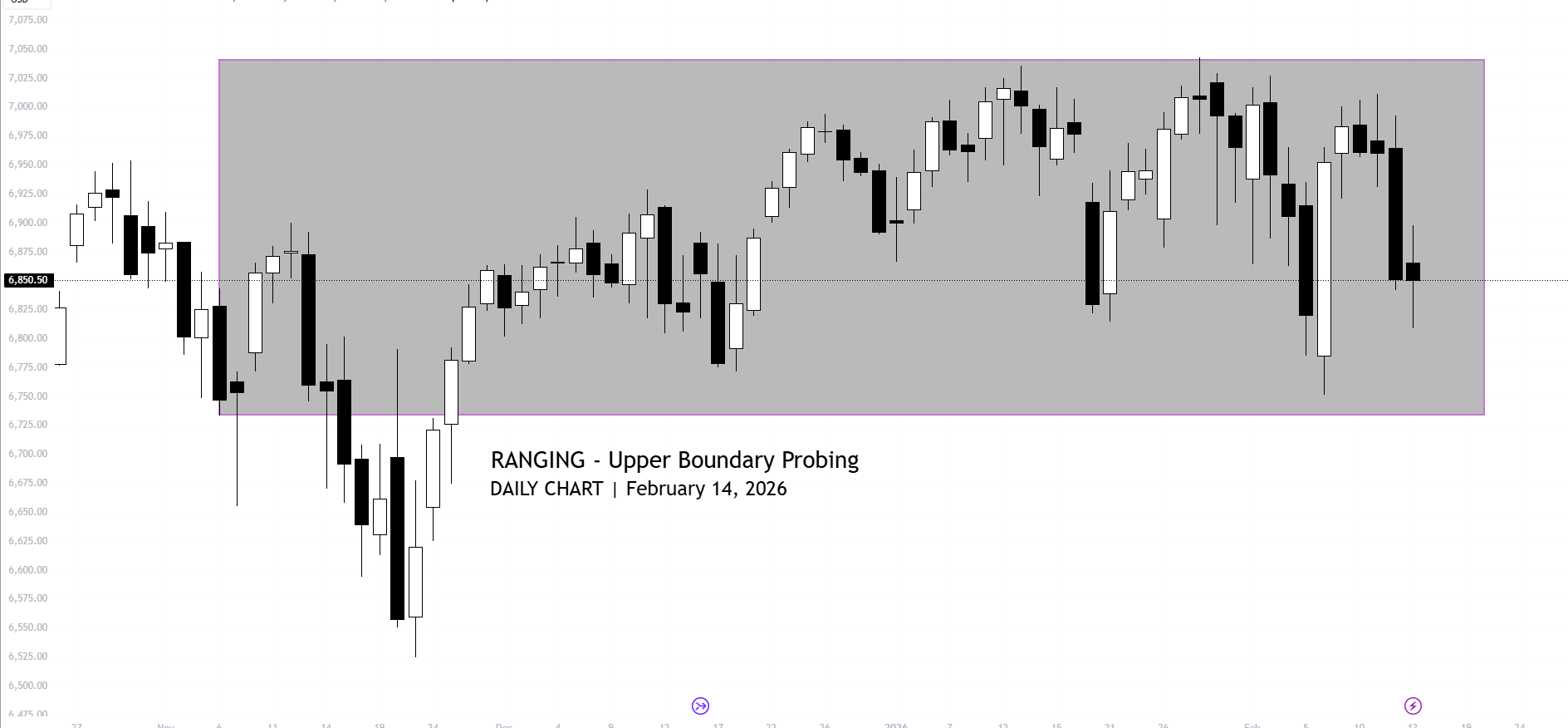
S&P 500 Futures – Weekly Environment Check
Price continues to rotate near the upper boundary of the established higher-timeframe range. Although volatility has contracted, structure remains overlapping and pullbacks lack the shallow, impulsive character typical of compression. Current behavior reflects balance rather than directional preparation.
Volatility and participation remain mixed and unstable. Expansion phases are frequently followed by sharp reversals, and directional attempts lack sustained follow-through. Participation is inconsistent, and price repeatedly fails to maintain structural acceptance beyond key levels.
Risk Assessment
Risk conditions are elevated. The market remains rotational with intermittent transitional pressure. Volatility alternates between expansion and contraction without sustained directional acceptance. Breakouts and reversals both occur, reducing structural reliability and increasing false-signal probability.
Directional follow-through remains inconsistent, and rapid reversals are observed following expansion phases.
Risk Implications
• Increased need for structural confirmation
• Reduced breakout reliability
• Higher probability of failed continuation attempts
• Elevated risk of overtrading during rotational phases
• Position sizing discipline is critical
Key Conditions to Watch
Transition conditions may emerge if price achieves sustained acceptance beyond established range boundaries, supported by expanding volatility and directional follow-through.
Repeated probing without structural acceptance would reinforce continued rotational conditions.
Primary Scenario:
If structure remains intact and volatility continues alternating without sustained acceptance beyond range boundaries, the rotational regime remains valid and risk conditions remain neutral to elevated.
Alternate Scenario:
If price achieves sustained acceptance beyond range boundaries supported by aligned volatility expansion and directional follow-through, a regime shift toward directional conditions may be developing and reassessment is required.